



Quick Links
Breast Cancer Links
- Breast Cancer Overview
- Breast Cancer Resources
- IHC Atlas
- Clinical Case Reviews
- Spotlight Series
- Knowledge Check
Gastric Cancer Links


Welcome to the new, updated HER2Know
We have expanded our .
Looking for the original HER2Know breast cancer resources?


Discover the importance of HER2 IHC assessment in solid tumors.

That’s why HER2 IHC testing is recommended across multiple tumor types.2-12 Your role in evaluating the HER2 biomarker further is critical for patient care. We cannot over-express this enough.

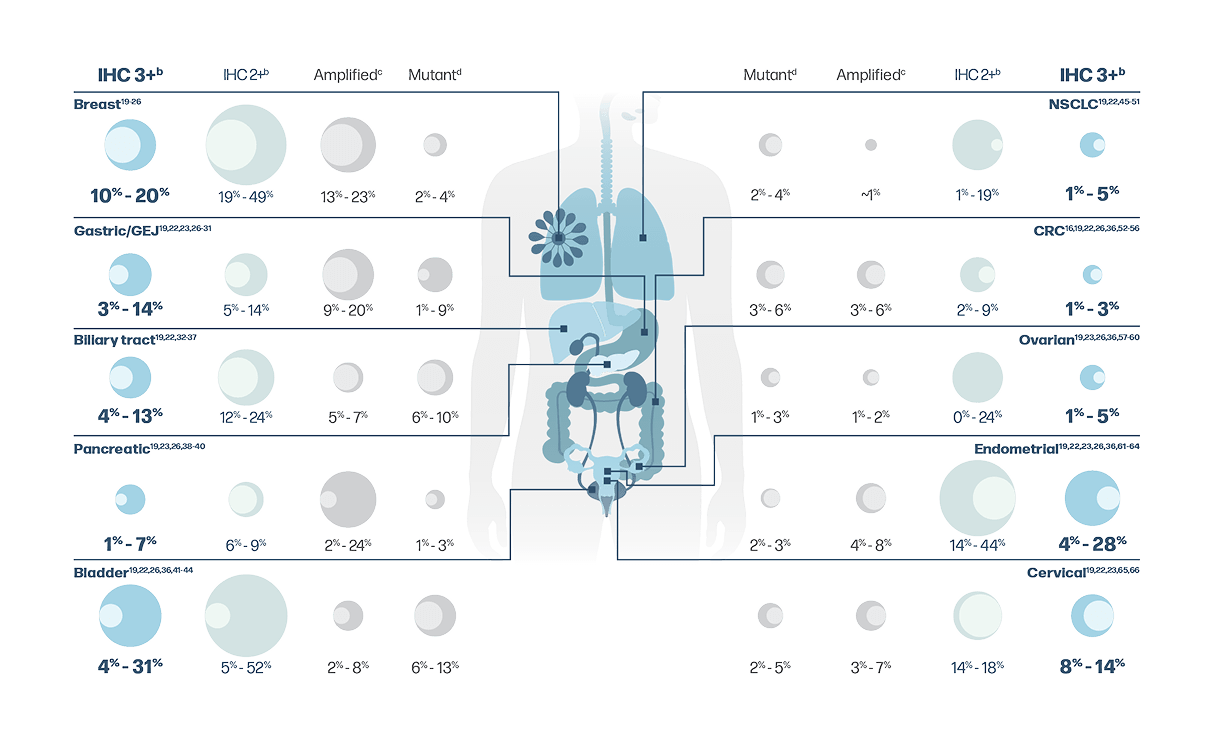
aIndividual tumor prevalence numbers reflect US and ex-US populations. Due to limited testing of IHC in the US, data from a global population have been included.
bHER2 protein expression is measured using IHC with confirmatory ISH testing in cases of equivocal results.67,68
cHER2 (ERBB2) amplification is measured using ISH techniques, including FISH, CISH, and SISH, or by NGS.50,69
dHER2 (ERBB2) mutations are detected through sequencing techniques, such as NGS.50,54
| Alteration | HER2 protein overexpression  |
HER2 (ERBB2) gene amplification  |
HER2 (ERBB2) gene mutation  |
|---|---|---|---|
| Definition | Overabundance of HER2 protein on the surface of tumor cells |
Elevated number of HER2 gene copies |
Activating mutation in the HER2 gene |
| Testing method | IHC | ISH or NGSe | NGSd |
eISH is a molecular testing method that detects
HER2 DNA copy number, while NGS detects both
HER2 DNA copy number and/or HER2
mutations.70,71


aTumor cell cluster (≥5 neoplastic cells).68
Figure adapted from: Bartley AN, et al. J Clin Oncol. 2017.68
Images provided by Discovery Life Sciences, Inc.
There are several key considerations in HER2 assay validation beyond the testing guidance for breast and gastric cancers, including which assay scoring system is used76
| Pathology specialty | Metastatic/advanced tumor type | NCCN Clinical Practice Guidelines in Oncology (NCCN Guidelines®) testing guidance | CAP Biomarker Reporting Template for HER2 testing results | Applicable HER2 IHC scoring criteria |
|---|---|---|---|---|
| Breast | Breast | IHC, ISH3,67,78 | Breast Biomarker Reporting Template | ASCO–CAP breast scoring criteriaa |
| Gastrointestinal | Biliary tract | IHC, FISH, NGS69,79 | General IHC Quantitative Biomarkers Template | No universal guideline (ASCO–CAP gastric scoring criteria may be used) |
| Gastric/GEJ | IHC, ISH, NGS5,68,80,81 | Gastric HER2 Biomarker Reporting Template | ASCO–CAP gastric scoring criteriaa | |
| Pancreatic | IHC, NGS (amplification)6,79 | General IHC Quantitative Biomarkers Template | No universal guideline (ASCO–CAP gastric scoring criteria may be used) | |
| Colorectal | IHC, FISH, NGS7,8,77 | Colon and Rectum Biomarker Reporting Template | ASCO–CAP gastric scoring criteria, ASCO–CAP breast scoring criteria, or HERACLES trial scoring criteriab,c | |
| Thoracic | NSCLC | IHC, NGS (mutation), targeted PCR2,82 | Lung Biomarker Reporting Template | No universal guideline (ASCO–CAP gastric scoring criteria may be used)d |
| Genitourinary | Bladder | IHC9,79 | General IHC Quantitative Biomarkers Template | No universal guideline (ASCO–CAP gastric scoring criteria may be used) |
| Gynecologic | Endometrial | IHC, FISH10,68,73 | Gynecologic Biomarker Reporting Template | ASCO–CAP gastric scoring criteria or Fader trial guidelinesc |
| Ovarian | IHC11,68,73 | Gynecologic Biomarker Reporting Template | ASCO–CAP gastric scoring criteriac | |
| Cervical | IHC, FISH12,68,73 | Gynecologic Biomarker Reporting Template | ASCO–CAP gastric scoring criteriac |
aCriteria recommended by ASCO-CAP.
bThere is no consensus on whether breast or gastric cancer scoring criteria should be applied to colorectal cancer. Some clinical trials have utilized ASCO-CAP breast scoring criteria, and others have utilized ASCO-CAP gastric cancer scoring criteria. Laboratory directors are asked to exercise their discretion as to which scoring criteria to apply.76
cCriteria included in CAP reporting template.
dScoring criteria for anti-HER2 monoclonal antibody/antibody-drug conjugate therapy is currently based on criteria initially applied in gastric carcinoma, which utilizes different scoring criteria than that utilized for breast carcinoma and employs different scoring criteria for small biopsy specimens versus resections.2
 BreastColon and rectumLungGynecologicGastric HER2Head and neck
For other tumor types, the CAP General IHC Quantitative Biomarkers Template is available.
Access all of the CAP templates listed above

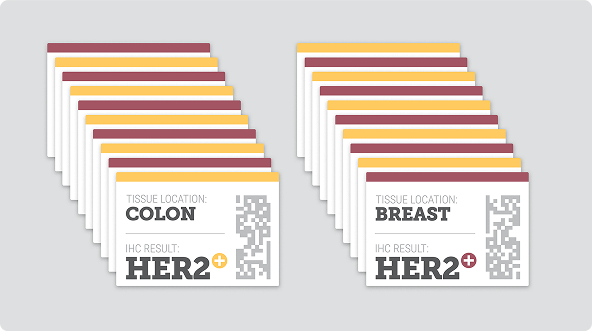
aUpdated in 2024.
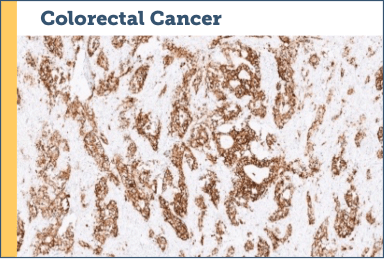
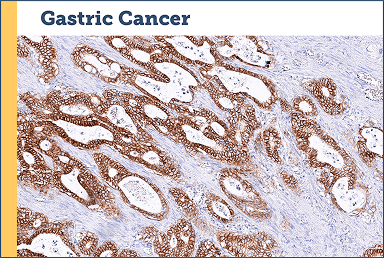
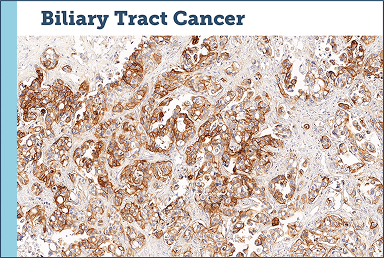
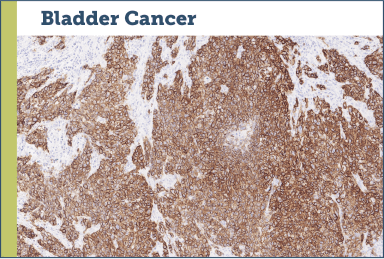

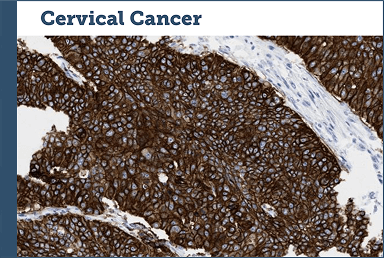
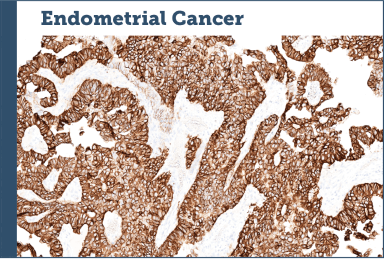
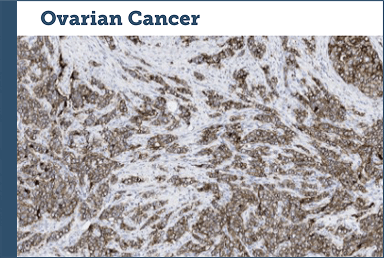

Images provided by Discovery Life Sciences, Inc.
HER2 COULD BE HERE, TOO

Perform HER2
IHC testing across metastatic solid tumor types to inform patient care
ASCO, American Society of Clinical Oncology; CAP, College of American Pathologists; CISH, chromogenic in situ hybridization; CRC, colorectal cancer; DNA, deoxyribonucleic acid; ERBB2, erb-b2 receptor tyrosine kinase 2; FISH, fluorescence in situ hybridization; GEJ, gastroesophageal junction; HER2, human epidermal growth factor receptor 2; IHC, immunohistochemistry; ISH, in situ hybridization; mNSCLC, metastatic non-small cell lung cancer; NCCN, National Comprehensive Cancer Network; NGS, next-generation sequencing; NSCLC, non-small cell lung cancer; SISH, silver-enhanced in situ hybridization.
1. Yan M, et al. Cancer Metastasis Rev. 2015;34(1):157–164. 2. Referenced with permission from the NCCN Clinical Practice Guidelines in Oncology (NCCN Guidelines®) for Non-Small Cell Lung Cancer V.7.2025. © National Comprehensive Cancer Network, Inc. 2025. All rights reserved. Accessed July 10, 2025. To view the most recent and complete version of the guideline, go online to NCCN.org. NCCN makes no warranties of any kind whatsoever regarding their content, use or application and disclaims any responsibility for their application or use in any way. 3. Referenced with permission from the NCCN Clinical Practice Guidelines in Oncology (NCCN Guidelines®) for Breast Cancer V.4.2025. © National Comprehensive Cancer Network, Inc. 2025. All rights reserved. Accessed April 17, 2025. To view the most recent and complete version of the guideline, go online to NCCN.org. NCCN makes no warranties of any kind whatsoever regarding their content, use or application and disclaims any responsibility for their application or use in any way. 4. Referenced with permission from the NCCN Clinical Practice Guidelines in Oncology (NCCN Guidelines®) for Biliary Tract Cancers V.2.2025. © National Comprehensive Cancer Network, Inc. 2025. All rights reserved. Accessed July 2, 2025. To view the most recent and complete version of the guideline, go online to NCCN.org. NCCN makes no warranties of any kind whatsoever regarding their content, use or application and disclaims any responsibility for their application or use in any way. 5. Referenced with permission from the NCCN Clinical Practice Guidelines in Oncology (NCCN Guidelines®) for Gastric Cancer V.2.2025. © National Comprehensive Cancer Network, Inc. 2025. All rights reserved. Accessed April 4, 2025. To view the most recent and complete version of the guideline, go online to NCCN.org. NCCN makes no warranties of any kind whatsoever regarding their content, use or application and disclaims any responsibility for their application or use in any way. 6. Referenced with permission from the NCCN Clinical Practice Guidelines in Oncology (NCCN Guidelines®) for Pancreatic Adenocarcinoma V.2.2025. © National Comprehensive Cancer Network, Inc. 2025. All rights reserved. Accessed February 3, 2025. To view the most recent and complete version of the guideline, go online to NCCN.org. NCCN makes no warranties of any kind whatsoever regarding their content, use or application and disclaims any responsibility for their application or use in any way. 7. Referenced with permission from the NCCN Clinical Practice Guidelines in Oncology (NCCN Guidelines®) for Colon Cancer V.4.2025. © National Comprehensive Cancer Network, Inc. 2025. All rights reserved. Accessed June 27, 2025. To view the most recent and complete version of the guideline, go online to NCCN.org. NCCN makes no warranties of any kind whatsoever regarding their content, use or application and disclaims any responsibility for their application or use in any way. 8. Referenced with permission from the NCCN Clinical Practice Guidelines in Oncology (NCCN Guidelines®) for Rectal Cancer V.2.2025. © National Comprehensive Cancer Network, Inc. 2025. All rights reserved. Accessed March 31, 2025. To view the most recent and complete version of the guideline, go online to NCCN.org. NCCN makes no warranties of any kind whatsoever regarding their content, use or application and disclaims any responsibility for their application or use in any way. 9. Referenced with permission from the NCCN Clinical Practice Guidelines in Oncology (NCCN Guidelines®) for Bladder Cancer V.1.2025. © National Comprehensive Cancer Network, Inc. 2025. All rights reserved. Accessed March 25, 2025. To view the most recent and complete version of the guideline, go online to NCCN.org. NCCN makes no warranties of any kind whatsoever regarding their content, use or application and disclaims any responsibility for their application or use in any way. 10. Referenced with permission from the NCCN Clinical Practice Guidelines in Oncology (NCCN Guidelines®) for Uterine Neoplasms V.3.2025. © National Comprehensive Cancer Network, Inc. 2025. All rights reserved. Accessed March 7, 2025. To view the most recent and complete version of the guideline, go online to NCCN.org. NCCN makes no warranties of any kind whatsoever regarding their content, use or application and disclaims any responsibility for their application or use in any way. 11. Referenced with permission from the NCCN Clinical Practice Guidelines in Oncology (NCCN Guidelines®) for Ovarian Cancer Including Fallopian Tube Cancer and Primary Peritoneal Cancer V.3.2025. © National Comprehensive Cancer Network, Inc. 2025. All rights reserved. Accessed July 16, 2025. To view the most recent and complete version of the guideline, go online to NCCN.org. NCCN makes no warranties of any kind whatsoever regarding their content, use or application and disclaims any responsibility for their application or use in any way. 12. Referenced with permission from the NCCN Clinical Practice Guidelines in Oncology (NCCN Guidelines®) for Cervical Cancer V.4.2025. © National Comprehensive Cancer Network, Inc. 2025. All rights reserved. Accessed March 24, 2025. To view the most recent and complete version of the guideline, go online to NCCN.org. NCCN makes no warranties of any kind whatsoever regarding their content, use or application and disclaims any responsibility for their application or use in any way. 13. Abrahao-Machado LF, et al. World J Gastroenterol. 2016;22(19):4619-4625. 14. Morrison C, et al. J Clin Oncol. 2006;24(15):2376-2385. 15. Luo H, et al. PLoS One. 2018;13(1):e0191972. 16. Wang XY, et al. World J Gastrointest Oncol. 2019;11(4):335-347. 17. Wang S, et al. Mod Pathol. 2023;36(6):100148. 18. Iqbal N, et al. Mol Biol Int. 2014;2014:852748. 19. Uzunparmak B, et al. Ann Oncol. 2023;34(11):1035-1046. 20. Farshid G, et al. Mod Pathol. 2020;33(9):1783-1790. 21. Rakha EA, et al. Br J Cancer. 2021;124(11):1836-1842. 22. Connell CM, et al. ESMO Open. 2017;2(5):e000279. 23. Chmielecki J, et al. Oncologist. 2015;20(1):7-12. 24. Owens MA, et al. Clin Breast Cancer. 2004;5(1):63-69. 25. Bose R, et al. Cancer Discov. 2013;3(2):224-237. 26. Subramanian J, et al. Oncologist. 2019;24(12):e1303-e1314. 27. Subasinghe D, et al. J Int Med Res. 2023;51(2):3000605231154403. 28. Van Cutsem E, et al. Gastric Cancer. 2015;18(3):476-484. 29. Gao X, et al. Int J Surg. 2023;109(5):1330-1341. 30. Im SA, et al. Diagn Mol Pathol. 2011;20(2):94-100. 31. Cappellesso R, et al. Hum Pathol. 2015;46(5):665-672. 32. Vivaldi C, et al. Oncologist. 2020;25(10):886-893. 33. Roa I, et al. Gastrointest Cancer Res. 2014;7(2):42-48. 34. Harder J, et al. World J Gastroenterol. 2009;15(36):4511-4517. 35. Nakazawa K, et al. J Pathol. 2005;206(3):356-365. 36. Dumbrava EEI, et al. JCO Precis Oncol. 2019;3:PO.18.00345. 37. Li M, et al. Nat Genet. 2014;46(8):872-876. 38. Han SH, et al. Diagnostics (Basel). 2021;11(4):653. 39. Chou A, et al. Genome Med. 2013;5(8):78. 40. Li X, et al. World J Surg Oncol. 2016;14:38. 41. Moktefi A, et al. Mod Pathol. 2018;31(8):1270-1281. 42. Gårdmark T, et al. BJU Int. 2005;95(7):982-986. 43. Fleischmann A, et al. Eur Urol. 2011;60(2):350-357. 44. Moustakas G, et al. J Int Med Res. 2020;48(1):300060519895847. 45. Zinner RG, et al. Lung Cancer. 2004;44(1):99-110. 46. Heinmöller P, et al. Clin Cancer Res. 2003;9(14):5238-5243. 47. Takenaka M, et al. Anticancer Res. 2011;31(12):4631-4636. 48. Nagasaka M, et al. Clin Lung Cancer. 2022;23(1):52-59. 49. Volckmar AL, et al. Int J Cancer. 2019;145(3):649-661. 50. Zhuo X, et al. J Cancer Res Clin Oncol. 2023;149(5):2029-2039. 51. Zhao J, et al. JCO Precis Oncol. 2020;4:411-425. 52. Ingold-Heppner B, et al. Br J Cancer. 2014;111(10):1977-1984. 53. Henry JT, et al. Chin Clin Oncol. 2019;8(5):49. 54. El-Deiry WS, et al. Cancer Biol Ther. 2015;16(12):1726-1737. 55. Seo AN, et al. PLoS One. 2014;9(5):e98528. 56. Raghav KPS, et al. Clin Cancer Res. 2024;30(2):260-262. 57. Tuefferd M, et al. PLoS One. 2007;2(11):e1138. 58. Pils D, et al. Br J Cancer. 2007;96(3):485-491. 59. Ersoy E, et al. Int J Gynecol Pathol. 2022;41(4):313-319. 60. Chung YW, et al. J Gynecol Oncol. 2019;30(5):e75. 61. Buza N, et al. Mod Pathol. 2013;26(12):1605-1612. 62. Vermij L, et al. Histopathology. 2021;79(4):533-543. 63. Semiz HS, et al. Turk Patoloji Derg. 2023;39(1):55-63. 64. Halle MK, et al. Br J Cancer. 2018;118(3):378-387. 65. Shi H, et al. J Pathol Clin Res. 2021;7(1):86-95. 66. Panek G, et al. Gin Onkol. 2007;5(4):218-235. 67. Wolff AC, et al. Arch Pathol Lab Med 2023;147(9):993-1000. 68. Bartley AN, et al. J Clin Oncol. 2017;35(4):446-464. 69. Hanna WM, et al. Mod Pathol. 2014;27(1):4-18. 70. Ren S, et al. ESMO Open. 2022;7(1):100395. 71. Morsberger L, et al. Cancer Cell Int. 2022;22(1):350. 72. Shayeb AM, et al. JCO Precis Oncol. 2023;7:e2200604. 73. College of American Pathologists. Template for Reporting Results of Biomarker Testing of Specimens from Patients with Carcinoma of Gynecologic Origin. Version: 1.2.0.0. 74. Rüschoff J, et al. Mod Pathol. 2012;25(5):637-650. 75. Data on file. Daiichi Sankyo, Inc. Basking Ridge, NJ. 76. Goldsmith JD, et al. Arch Pathol Lab Med. 2024;148(6):e111-e153. 77. College of American Pathologists. Template for Reporting Results of Biomarker Testing of Specimens from Patients with Carcinoma of the Colon and Rectum. Version: 1.3.0.0. 78. College of American Pathologists. Template for Reporting Results of Biomarker Testing of Specimens from Patients with Carcinoma of the Breast. Version: 1.6.0.0. 79. College of American Pathologists. Template for Reporting Results of Biomarker Testing of Specimens from Patients with Carcinoma. Version: 1.1.0.1. 80. Referenced with permission from the NCCN Clinical Practice Guidelines in Oncology (NCCN Guidelines®) for Esophageal and Esophagogastric Junction Cancers V.3.2025. © National Comprehensive Cancer Network, Inc. 2025. All rights reserved. Accessed April 22, 2025. To view the most recent and complete version of the guideline, go online to NCCN.org. NCCN makes no warranties of any kind whatsoever regarding their content, use or application and disclaims any responsibility for their application or use in any way. 81. Reporting Template for Reporting Results of Biomarker Testing of Specimens from Patients with Adenocarcinoma of the Stomach or Gastroesophageal Junction. Version: 17-1001. 82. Reporting Template for Reporting Results of Biomarker Testing of Specimens from Patients with Non-small Cell Carcinoma of the Lung. Version: 2.0.1.1. 83. CAP. Head and Neck Biomarker Reporting Template. Version: 2.2.0.0.
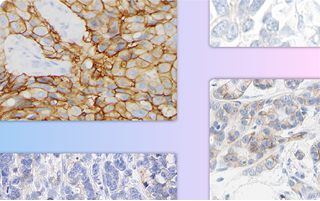
Examine real-world staining patterns across 100+ clinical cases to support HER2 IHC scoring in your practice.
Explore the cases

Overview of the CAP reporting template update and guidance for IHC scoring.
Read the article
Overview of HER2 testing recommendations from NCCN Guidelines.
Read the article

©2025 Daiichi Sankyo, Inc. and AstraZeneca.
US-99813, PP-US-8201a-2323 08/25

Request an AstraZeneca Medical Affairs Representative Follow-Up
This website is intended to help healthcare professionals practicing in the United States find and access scientifically balanced, evidence-based, and peer-led information and professional resources in support of HER2 IHC evaluation. The dissemination of this information may be subject to different medical and regulatory requirements in other countries. This information is provided for educational purposes only. It is not intended for use in the diagnosis or treatment of individual patients. Are you a healthcare professional practicing in the United States?
I am a Daiichi Sankyo Company or AstraZeneca authorized person
This website is only intended for healthcare professionals practicing in the United States and authorized Daiichi Sankyo Company or AstraZeneca personnel. US Headquarters personnel and US Field Medical personnel are authorized to browse and search the database for their own background knowledge and insight. This website is not intended for use by US Field Sales personnel. None of the content of this site should be directly linked or distributed without approval.
