

HER2Know Logo
HER2Know Logo
  • Tumor Types
    • Welcome to the new, updated HER2Know

      We have expanded our resource library so you can now explore content on HER2 in tumors beyond breast.

      Looking for the original HER2Know breast cancer resources?

      • Breast Cancer
        • Breast Cancer Overview
        • Breast Cancer Resources
        • IHC Atlas
        • Pathologists' Perspectives
          • Clinical Case Reviews
          • Spotlight Series
        • Knowledge Check
      • Gastric Cancer
        • Gastric Cancer Overview
        • Gastric Cancer Resources
        • Gastric Cancer IHC Atlas
      • Other Solid Tumors
        • Other Solid Tumors Overview
        • Other Solid Tumors Resources
        • Other Solid Tumors IHC Atlas
       
  • Resources
  • IHC Atlas
  • Contributors
  • In the Know
  • Subscribe
  • TUMOR TYPES
  • Breast Cancer
    • Breast Cancer Overview
    • Breast Cancer Resources
    • IHC Atlas
    • Pathologists' perspectives
    • Clinical Case Reviews
    • Spotlight Series
    • Knowledge Check
  • Gastric Cancer
    • Gastric Cancer Overview
    • Gastric Cancer Resources
    • Gastric Cancer IHC Atlas
  • Other Solid Tumors
    • Other Solid Tumors Overview
    • Other Solid Tumors Resources
    • Other Solid Tumors IHC Atlas
  • Resources
  • IHC Atlas
  • Contributors
  • In the Know
  • Subscribe
  • ...
  • Pathologists' Perspectives
  • Clinical Case Reviews
  • The importance of reporting discrete HER2 IHC scores
  • Back to Clinical Case Reviews

The importance of reporting discrete HER2 IHC scores

Case contributed by Marilyn Bui, MD, PhD

 
  •  LinkedIn
  • X
  • Facebook
The importance of reporting discrete HER2 IHC scores

Marilyn Bui

MD, PhD

Case details

  • Age

    58
  • Gender

    Female

  • Tumor grade

    Initial biopsy: Grade 2
    Lumpectomy: Grade 3
    (Glandular/tubular formation score: 3/3
    Nuclear pleomorphism score: 3/3
    Mitotic rate score: 2/3)
    Overall score: 8/9
  • Specimen type in primary setting

    Biopsy left breast
  • Type of breast cancer

    Invasive ductal carcinoma with lobular features
  • Hormone receptor status

    ER: Positive (90%)
    PR: Positive (30%)
  • HER2 by IHC

    Negative (discrete IHC not reported)
  • Treatment received

    Lumpectomy followed by radiation
    therapy
    Patient stopped treatment with hormone
    therapy
  • Disease progression

    Two years later, PET/CT scan showed multiple enlarged left internal mammary lymph nodes and following a biopsy, metastatic carcinoma of the breast was identified

  • Type of breast cancer

    Left breast invasive ductal carcinoma with lobular features
  • Hormone receptor status

    ER: Negative
    PR: Negative
  • HER2 by IHC

    Equivocal (2+)
  • HER2 by CISH

    Negative (not amplified)
  • Pre-analytic variables and technical issues

    None
In this case, the patient presented with a primary breast cancer classified as HER2-negative. This was a referral case and the discrete HER2 IHC score was not reported from the outside institution. Following progression of the disease, the patient’s metastatic sample was found to be HER2 IHC 2+ (equivocal), with negative CISH, which also categorized the metastatic sample as HER2-negative. From primary to metastatic disease, the change in HER2 IHC score was unknown; the score may have changed from either IHC 0 to IHC 2+, or IHC 1+ to IHC 2+. This case highlights the importance of reporting discrete HER2 IHC scores, as opposed to binary HER2-positive or -negative results.

Case summary

A biopsy and subsequent left breast lumpectomy were performed at an outside institution on a 58-year-old female, and she was found to have invasive ductal carcinoma with lobular features. After HER2 IHC evaluation, the tumor was reported to be HER2-negative with no subsequent reflex ISH testing. No discrete IHC score was provided in the referral report, and therefore, it was not possible to determine whether the sample was HER2 0 or 1+ by IHC. The patient was then treated with radiotherapy as well as hormone therapy; however, hormone therapy was stopped secondary to side effects.

Two years later, a PET/CT scan showed multiple enlarged left internal mammary lymph nodes with increased FDG avidity, suggestive of metastatic disease. A CT-guided biopsy of a left internal mammary node was performed. The biopsy identified metastatic carcinoma of the breast (positive CK7 and GATA3 by IHC). The tumor was scored as HER2 IHC 2+. FISH could not be performed due to insufficient sample. Chemotherapy was initiated.

Following treatment with chemotherapy, a CT-guided biopsy of the left chest wall again showed metastatic disease of breast origin (positive CK7 and GATA3 by IHC). HER2 IHC evaluation was performed and was scored as IHC 2+ with negative CISH.

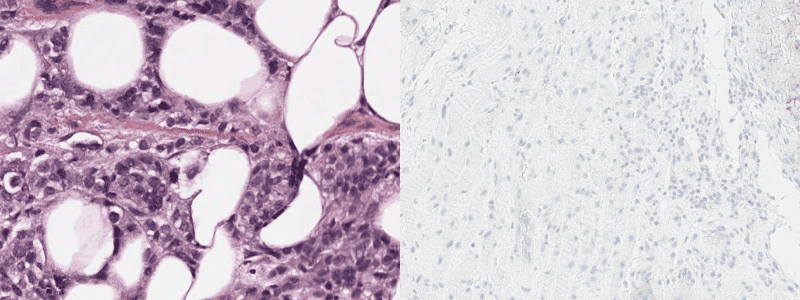
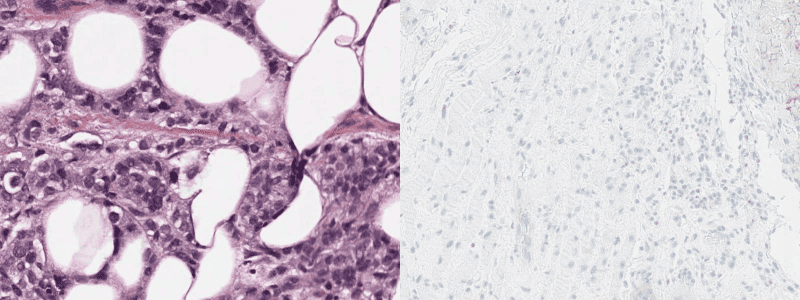
Figure 1. Left chest wall metastasis. a. H&E stain (20X). b. HER2 IHC stain (IHC 2+, 20X).

View whole slide image

What does the HER2 IHC staining indicate?

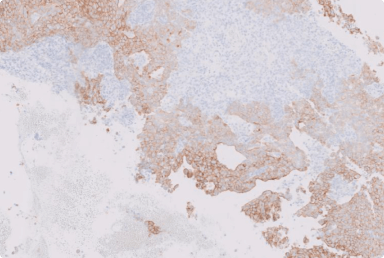
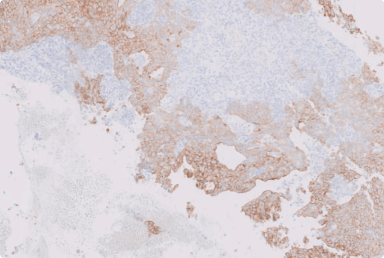
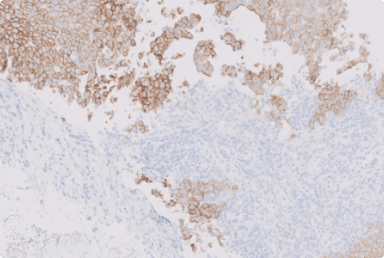
The specimen from CT-guided biopsy of the left chest wall metastatic breast cancer (Figure 1) shows complete membrane staining of moderate intensity in >10% of tumor cells, and therefore, was scored as HER2 IHC 2+. CISH was performed and was negative (HER2/CEP17 ratio = 1.26, HER2 copy = 2.40, and CEP17 copy = 1.90).

The interpretation was made following the 2018 ASCO-CAP HER2 guidelines, which state that equivocal IHC (2+) is weak-to-moderate complete membrane staining in >10% of tumor cells, or complete/circumferential membrane staining that is intense in ≤10% of the invasive tumor cells.1

A supporting visual guide for HER2 differentiation can help with HER2 IHC assessment in clinical practice. The guide can be found here.

Discussion

In this case, although both primary and metastatic samples were HER2-negative, the difference in HER2 IHC score was unknown; the score may have changed from either IHC 0 to IHC 2+, or IHC 1+ to IHC 2+. This case highlights the importance of reporting discrete HER2 IHC scores as opposed to binary HER2-positive or -negative results. Reporting the discrete score provides a higher level of information, which is especially helpful to compare with if further testing occurs in a patient’s disease course.

As we now recognize the full spectrum of HER2 expression, providing discrete IHC scores in the pathology report is key to gaining a better overall understanding of a patient’s disease. Having detailed biomarker information at all stages of a patient’s journey with breast cancer may help to better inform clinical care and treatment decisions.

Considerations

  • HER2 IHC scores can differ between primary and metastatic samples. According to the 2023 ASCO-CAP guideline update, HER2 IHC testing should be repeated on metastatic specimens1
  • Include discrete HER2 IHC scores in the pathology report*


You can find more information on how to approach similar challenging cases in the e-learning series titled Interpreting HER2 in breast cancer: A full spectrum of possibilities, found in the Breast Cancer Resources.

*These practice considerations represent the opinions of the Breast Pathology Faculty. Members of the Breast Pathology Faculty have been contracted as paid advisors through Daiichi Sankyo and AstraZeneca and have received compensation for their time.

ASCO, American Society of Clinical Oncology; CAP, College of American Pathologists; CEP17, chromosome enumeration probe 17; CISH, chromogenic in situ hybridization; CK7, cytokeratin 7; CT, computed tomography; CISH, chromogenic in situ hybridization; ER, estrogen receptor; FDG, fluorodeoxyglucose; FISH, fluorescence in situ hybridization; GATA3, GATA binding protein 3; H&E, hematoxylin and eosin stain; HER2, human epidermal growth factor receptor 2; IHC, immunohistochemistry; ISH, in situ hybridization; PET, positron emission tomography; PR, progesterone receptor.

1. Wolff AC, et al. Arch Pathol Lab Med. 2023;147(9):993-1000.

Did you find this content useful?
Help us get it right next time by liking this article

.

Explore more Clinical Case Reviews

View all

In this series of articles, the Pathology Faculty share their experience with complex clinical cases and highlight practices that help to aid consistency in HER2 IHC scoring.

View all

Assessing HER2 IHC with cytoplasmic staining

In this case, the HER2 IHC on a segmental mastectomy specimen from a primary invasive ductal carcinoma showed an unusual cytoplasmic staining pattern.

by Savitri Krishnamurthy, MD

 
  •  LinkedIn
  • X
  • Facebook

Assessing HER2 IHC with edge artifacts

In this case, the HER2 IHC of a core needle biopsy specimen from an invasive breast carcinoma showed signs of edge artifact.

by Gary Tozbikian, MD

 
  •  LinkedIn
  • X
  • Facebook

Interpreting HER2 IHC with an extensive in situ component

In this case, there was an extensive in situ component present along with the invasive carcinoma, and HER2 IHC scores were discordant between the two.

by Hannah Wen, MD, PhD

 
  •  LinkedIn
  • X
  • Facebook
Her2know Logo

Quick Links

  • Subscribe
  • Resources
  • Contributors


Breast Cancer Links

  • Breast Cancer Overview
  • Breast Cancer Resources
  • IHC Atlas
  • Clinical Case Reviews
  • Spotlight Series
  • Knowledge Check


Gastric Cancer Links

  • Gastric Cancer Overview
  • Gastric Cancer Resources

About Us

  • Contact Us
  • Request Medical Follow-Up
  • AstraZeneca
  • AZ Medical
  • Daiichi Sankyo Company
  • DSI Medical
  • Your Privacy Choices

Legal

  • Privacy Notice
  • Cookie Preferences
  • Legal Notices & Terms of Use
  • Consumer Health Data Privacy Notice
.
Daiichi-Sankyo - AstraZeneca Footer

©2025 Daiichi Sankyo, Inc. and AstraZeneca
PP-US-8201a-2248, PP-US-8201a-1849, PP-US-8201a-2036, US-84238, US-93987, US-102659 11/25

HER2Know Logo

Request an AstraZeneca Medical Affairs Representative Follow-Up

Welcome to HER2Know

This website is intended to help healthcare professionals practicing in the United States find and access scientifically balanced, evidence-based, and peer-led information and professional resources in support of HER2 IHC evaluation. The dissemination of this information may be subject to different medical and regulatory requirements in other countries. This information is provided for educational purposes only. It is not intended for use in the diagnosis or treatment of individual patients. Are you a healthcare professional practicing in the United States?

I am a Daiichi Sankyo Company or AstraZeneca authorized person

What is a Daiichi Sankyo Company or AstraZeneca authorized person?

This website is only intended for healthcare professionals practicing in the United States and authorized Daiichi Sankyo Company or AstraZeneca personnel. US Headquarters personnel and US Field Medical personnel are authorized to browse and search the database for their own background knowledge and insight. This website is not intended for use by US Field Sales personnel. None of the content of this site should be directly linked or distributed without approval.

Self Certification Buttons
No, take me to AstraZeneca.com Self Certification Buttons